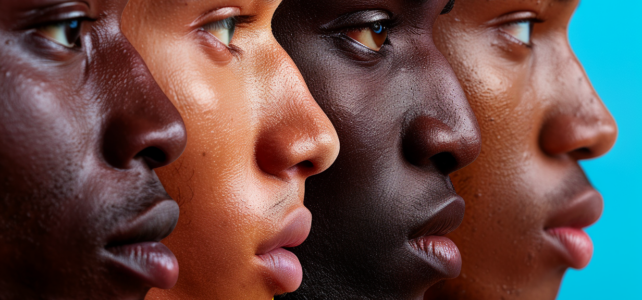
The shape of the nose is one of the most distinctive features of the human face, profoundly influencing the perception of individual and cultural beauty. The various types of noses, whether aquiline, flat, wide, or pointed, are perceived and valued differently around the world. These variations reflect not only a genetic richness but also aesthetic standards that evolve over time and with cultural influences. The appreciation of these nasal traits varies greatly, highlighting the importance of aesthetic criteria in shaping identity and personal attractiveness.
The diversity of nasal shapes and their aesthetic perception
Nasal morphology, an integral part of the face and respiratory pathways, plays a fundamental role in smell and breathing. The nasal septum, populated with blood vessels and mucus glands, is essential for humidifying, filtering, and warming the air. The varieties of nose shapes, including the straight nose, concave nose, or aquiline nose, are aesthetically perceived distinctly according to cultures and eras. An aquiline nose in men, for example, can evoke nobility and character, while a turned-up nose may be associated with youth and carefreeness.
The characteristics of the nose, such as convexity, flaring, or twisting, are not mere physical traits; they carry a wealth of meanings that emerge in the perception of beauty and personal identity. The nasal septum, in the case of deviation, can influence the aesthetic appearance of the nose, sometimes making it hooked, a trait that may or may not be valued depending on current aesthetic standards. The types of noses, ranging from the Nubian nose to the snub nose and the Bourbon nose, thus constitute a vast array where each shape finds its place in the spectrum of nasal aesthetics.
Aesthetic surgery, with techniques such as ethnic rhinoplasty or liquid rhinoplasty, allows for modifications of these characteristics to meet individual desires for facial harmony. Injections of hyaluronic acid or Botox are used to refine the nasal profile, correct a hooked nose, or adjust the tip of a nose. Surgeons like Dr. Mickaël DURBEC, a specialist in rhinoplasty in Lyon, work on redefining nasal aesthetics, attesting to the ever-growing demand for these procedures that combine function and aesthetics.

The impact of nasal characteristics on identity and aesthetic surgery
The nose, far more than just a respiratory organ, shapes identity and self-image. Its functions of smell, breathing, and its central position on the face make it a key vector of individual aesthetics. The **nasal septum**, with its cavities filled with blood vessels and mucus glands, ensures vital functions of humidifying, filtering, and warming the air. Beyond these biological functions, variations in its shape **deviation**, **hooked nose** can influence appearance and spark the desire for aesthetic correction.
In the field of aesthetic surgery, techniques such as **ethnic rhinoplasty** and **liquid rhinoplasty** allow for the correction of traits deemed unaesthetic or not harmonious with the rest of the face. **Injections of hyaluronic acid** or **Botox** are frequently sought to refine characteristics such as the **nasal profile** or the **tip of the nose**, thus highlighting the trend to personalize appearance according to an ideal of beauty.
Dr. Mickaël DURBEC, an aesthetic surgeon based in Lyon, is recognized for his expertise in **rhinoplasty**. His approach, which combines respect for ethnic traits and the pursuit of facial harmony, reflects the evolution of practices towards a precise and personalized adjustment of nasal contours. Noses once stigmatized, such as the **hooked nose** or the **aquiline nose**, can today be reshaped while preserving the authenticity of individual identity.
This quest for aesthetic perfection, however, is not limited to a simple physical modification. It reflects a deep aspiration for alignment between being and appearing, between self-esteem and the reflection in the mirror. Plastic surgery, by modifying nasal characteristics, thus plays a leading role in the construction of personal identity and in the expression of each individual’s uniqueness.