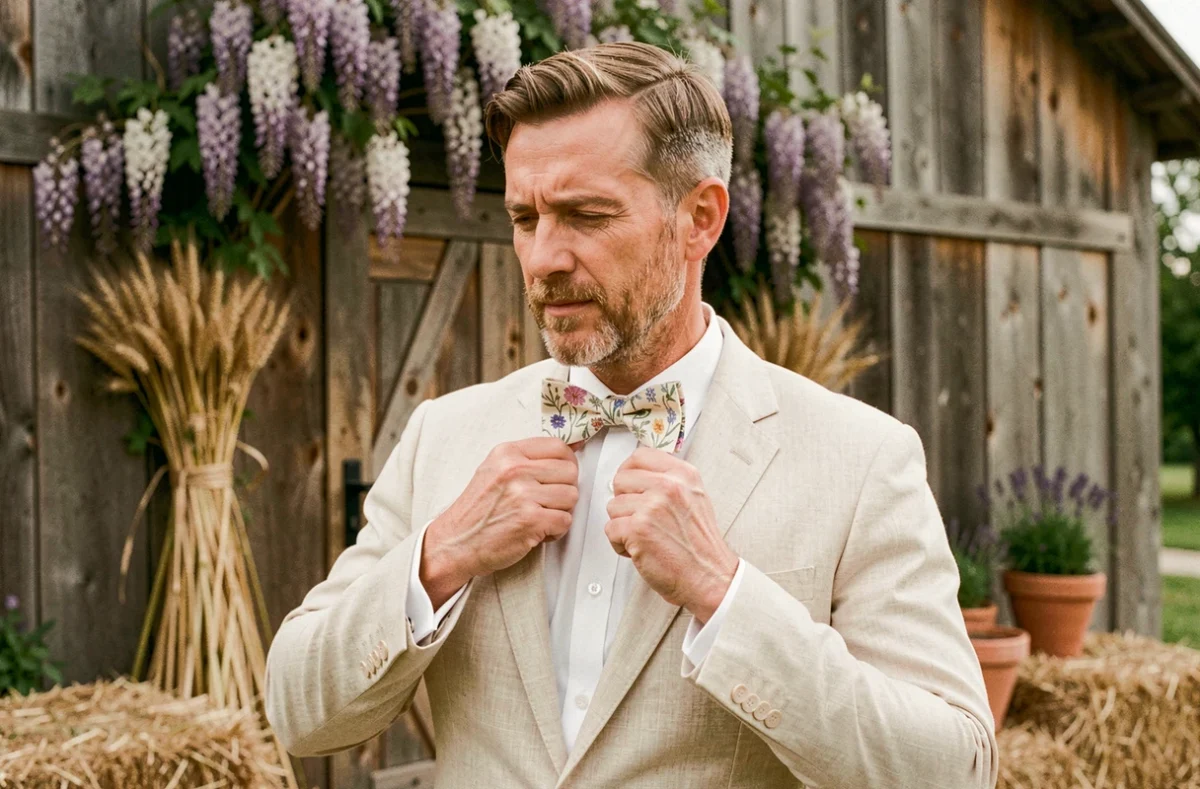
The bow tie for a country wedding is not just an aesthetic choice. It is a technical decision that engages the textile coherence of the entire outfit, from the groom to the wedding party. The material, the shape of the bow, and the color palette must meet the constraints of an outdoor setting, often in natural light, with omnipresent plant textures in the decoration.
Linen or cotton bow tie: the textile choice that conditions everything else
A country wedding requires natural fibers. Linen and cotton dominate for a simple reason: they absorb light instead of reflecting it, which avoids the “added piece” effect that you get with a satin or smooth silk bow tie placed on a raw fabric suit.
Wrinkled linen, far from being a flaw, enhances the sought-after rustic aesthetic. We recommend a linen of sufficient density so that the bow maintains its shape throughout the day, especially outdoors where heat softens fibers that are too fine.
Cotton works well in printed patterns (liberty, micro-floral), while linen is better suited to solid colors. Mixing the two within the wedding party, with tones from the same palette, creates coherence without uniformity. Exploring the bow tie on Hucky allows you to identify the combinations that work in this country style.
The wooden bow tie, often presented as the default original option, deserves a caveat: it stiffens the collar and prevents any adjustments during the day. For a long ceremony with an outdoor cocktail, a soft bow is more comfortable than a rigid accessory.
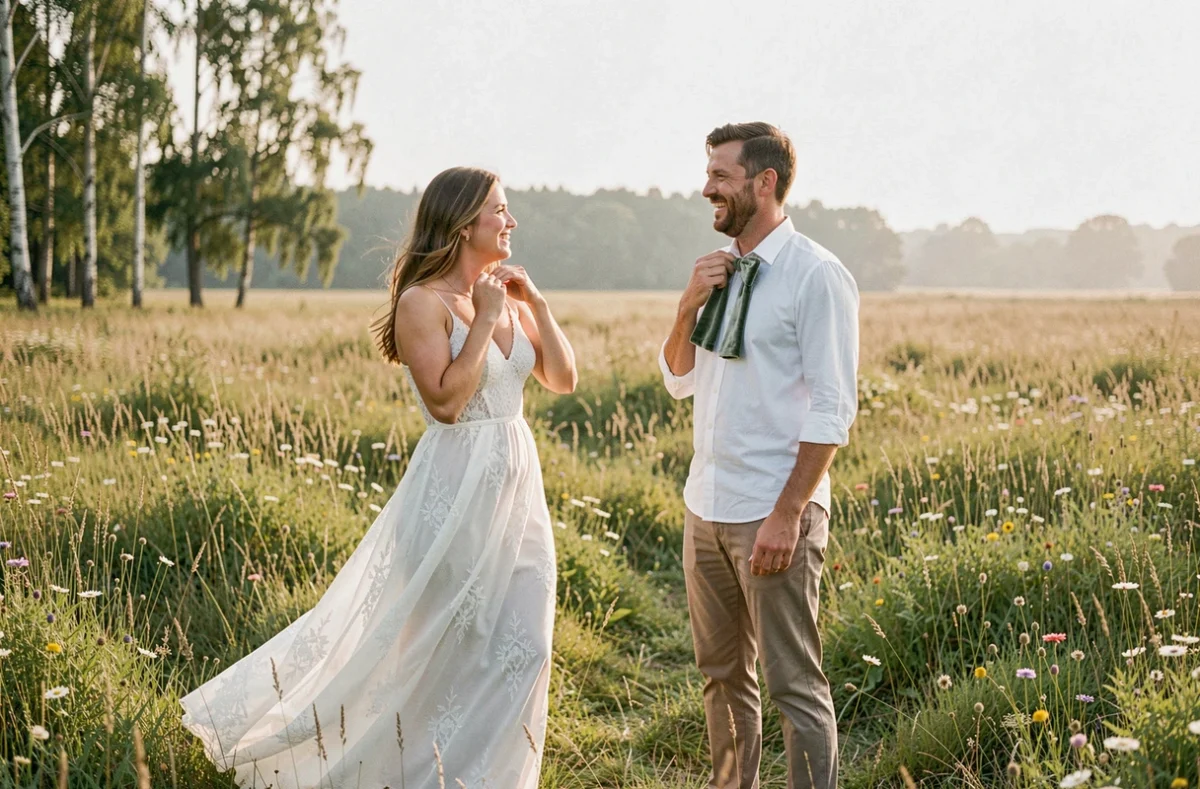
Country palette 2025-2026: sage green, terracotta, and coordinated bow tie
Classic palettes (navy blue, burgundy, beige) are declining. Custom suit shops are now steering nature-themed weddings towards shades like sage green or terracotta, paired with natural linen or subtly floral bow ties. This recent chromatic evolution changes the logic of matching.
On a sage green suit, an ecru or cream bow tie in raw linen creates a soft contrast. On terracotta, a bow in a muted mustard tone or sandy beige works without overpowering the suit. The rule: the bow tie should never be the most saturated piece of the outfit.
Difference between country and bohemian: two accessory logics
Consumer articles often mix country and bohemian styles, whereas decorators and brands clearly distinguish between the two. Country relies on raw materials, earthy tones, and an agricultural or pastoral setting. Bohemian incorporates more fluidity, layering, jewelry, and feathers.
In practice, this changes the bow tie: country calls for a structured bow in thick linen or cotton, while bohemian tolerates a softer, even asymmetrical bow. Confusing the two styles leads to visual inconsistencies in group photos.
Coordination of the wedding party: adjustable bow ties and intergenerational coherence
Dressing the groomsmen and witnesses in matching bow ties raises a technical issue that competing articles gloss over: the sizes vary, and a pre-tied one-size bow does not fit all neck sizes.
There are now ranges of harmonized bow ties in eucalyptus or earthy shades, with adjustable systems designed to accommodate different body types. Intergenerational coordination (father of the groom, honorary children, witnesses) then becomes achievable without sacrificing comfort.
- Prefer models with adjustable straps rather than fixed elastics, especially for children who move all day
- Vary the shades within the same color family: a lighter tone for children, deeper for adults
- Plan a spare bow for the groom, as the main bow may loosen after several hours
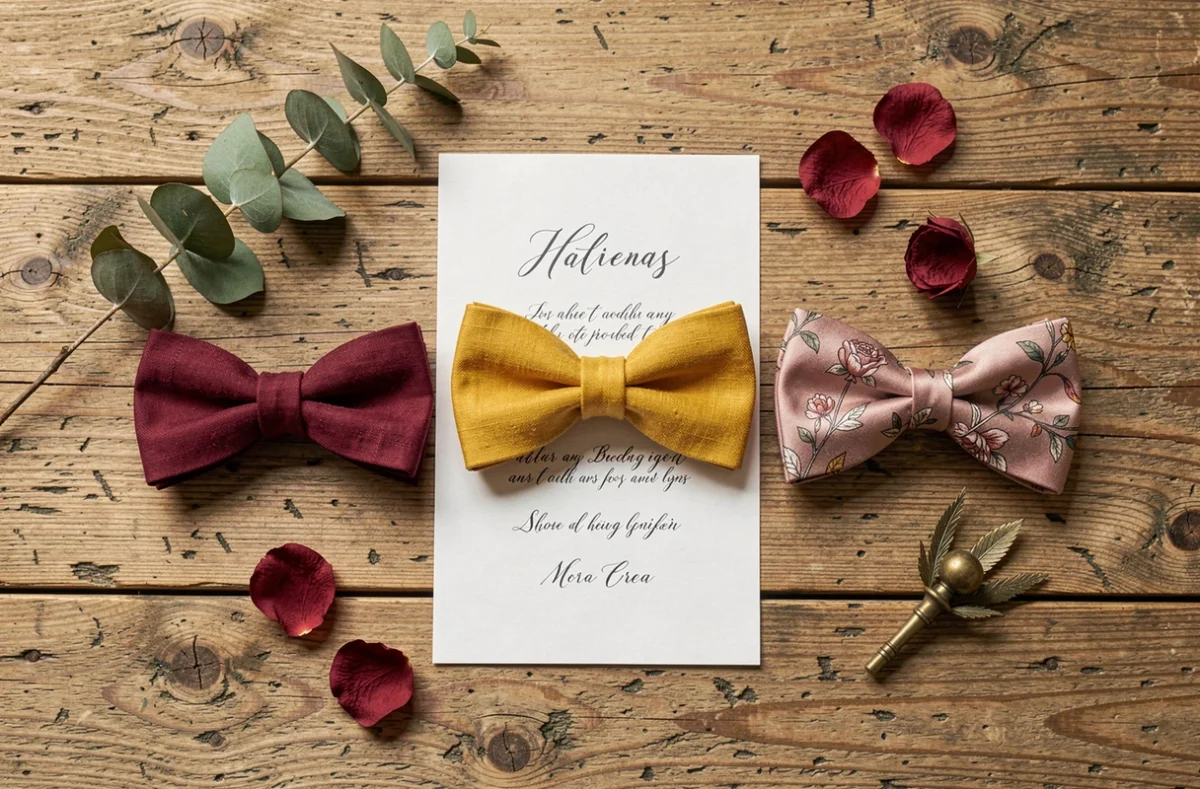
Self-tie bow tie or pre-tied: a choice that shows
The self-tie bow tie produces a slight asymmetry that adds character to the outfit. The pre-tied offers perfect symmetry but a more rigid look. In a country context, the controlled imperfection of the self-tie fits better with the natural aesthetic.
The real barrier is the technique. Tying a bow tie requires a few minutes of learning, but the stress of the big day pushes most grooms towards the pre-tied option. We observe that self-tie linen bows forgive tightening mistakes better than silk ones, thanks to the natural rigidity of the fiber.
The accessory as the unique strong piece of the outfit
An increasingly assertive positioning among wedding stylists: the bow tie should be the only strong piece of the upper body. Accumulating pocket squares, brooches, collar pins, and bow ties dilutes the effect. A well-chosen bow tie is enough to structure the entire outfit.
This minimalist approach works particularly well in country settings, where floral decoration and the natural environment already provide a lot of visual richness. The groom does not need to compete with the decor.
- The bow tie replaces the tie and pocket square, not both as a complement
- If a waistcoat is worn, choose a bow in a neutral tone to avoid overloading the torso
- Cufflinks remain compatible, provided they are discreet (no shiny metal)
A natural linen bow tie, well proportioned to the face and coordinated with the wedding party, gives more personality than an extravagant accessory poorly integrated. The country wedding values accuracy over display, and that is exactly what a well-thought-out bow tie brings to the groom’s outfit.