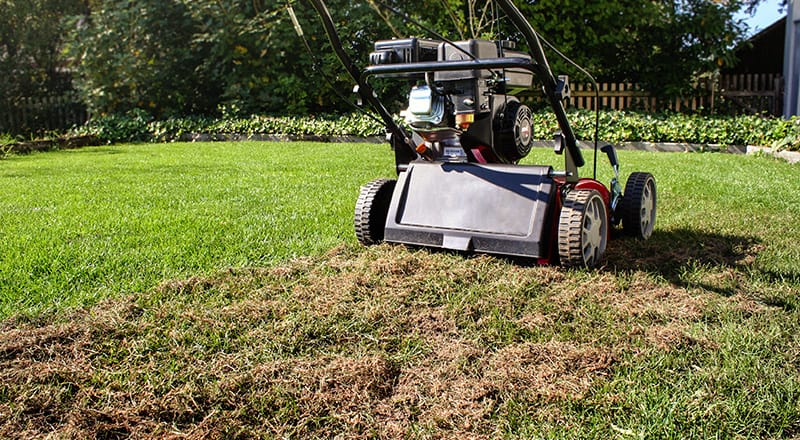
When taking care of the garden, lawn maintenance is rarely a priority. However, a beautiful lawn makes all the difference. Properly maintaining your lawn is not a complicated task. You just need to take care of it regularly if you want it to stay healthy. One of the methods for caring for your lawn is scarification. Why scarify your lawn? This is the main question we will answer in this article.
Scarifying your lawn: why?
Over time, it is evident that your lawn deteriorates. With rain, foot traffic, and mowing, the quality of your garden cannot improve. Clippings, moss, and dead roots can accumulate and heavily pollute your grass. This layer will then retain moisture and prevent your lawn from truly absorbing water, nutrients, and air.
Scarification is a method that will allow your grass to regenerate by aerating the soil and reducing the waste from cut grass. It involves removing moss and thatch, thereby preventing the spread of diseases. Scarification will result in a lawn that is much more resistant to diseases and much denser. It is therefore recommended to scarify your lawn at least twice a year. The best times to carry out this scarification are in spring and autumn.
How to proceed with the scarification of your lawn?
It is advisable to perform a complete mowing of your lawn before scarifying it. This will help remove dead roots and moss. Mowing will also remove any troublesome leaves. Use the best machines to carry out your mowing. For the most inaccessible areas, you can use a Black and Decker trimmer. Furthermore, during the scarification of your lawn, you can take the opportunity to apply fertilizer and reseed the lawn itself.
Scarification should be done on damp ground, which is neither waterlogged nor too dry. If necessary, it may be required to water the lawn beforehand. Scarification should be done in a crossed manner to avoid any unscarified areas. As for the depth of scarification, it should be between 2 to 4 mm. Scarifying too deeply can lead to uprooting the roots. Regarding the waste from scarification, you should collect it carefully. For this purpose, you can use a scarifier equipped with a collection bag or a mower.
If you have fruit shrubs, the scarified moss could be used as organic compost to maintain them.
What equipment?
It is important to equip yourself to carry out the scarification. To succeed in this activity, you might consider using a thermal scarifier depending on the size of the lawn you need to maintain. Also, think about choosing equipment that does not make too much noise or cause excessive projections.