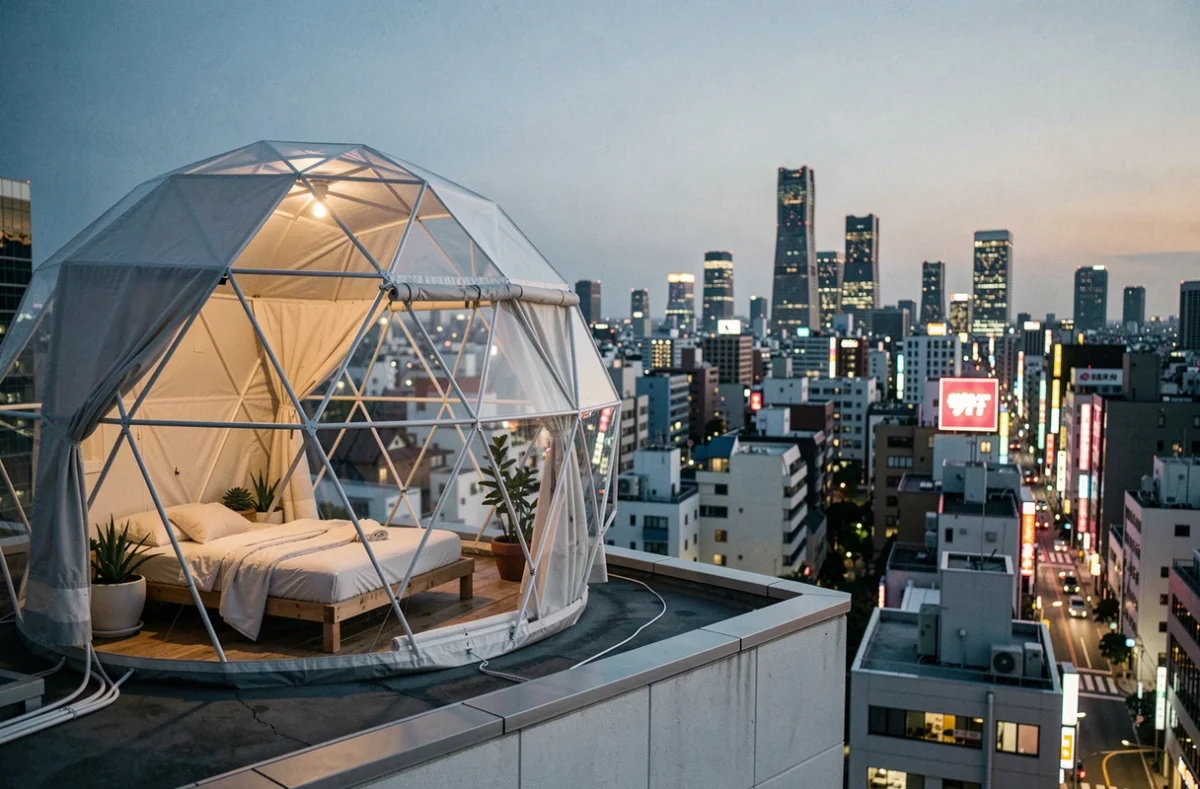
A rooftop bar with a panoramic view is well-known to everyone. Sleeping on a roof, in a structure designed as a true unusual accommodation, follows a different logic. Between structural constraints, local regulations, and the upscale trend of permanent glamping, accommodations perched on rooftops raise technical questions that simple address lists do not address.
Technical constraints of unusual rooftop accommodation
Installing a cabin, a dome, or a cabin on a roof is not just about placing a lightweight structure on a terrace. Each project must navigate several regulatory layers that vary significantly from country to country and municipality to municipality.
In the United States, accessible rooftop projects rely on local codes, adaptations of the IBC/IRC, and fire safety standards. In Europe, urban planning rules, the structural capacity of the building, wind or snow loads, waterproofing, fire evacuation, guardrails, and accessibility form a multidimensional framework.
An address presented as “perched on a roof” may therefore rely on very different regulatory foundations from one country to another. Checking the local legal framework remains the first step before any stay or investment.
Among the rooftop accommodations around the world, some stand out for their ability to combine comfort and technical compliance, while others remain simple temporary installations without insulation or permanent connections.
Permanent glamping or event installation: comparative table
The glamping market trend is shifting towards permanent structures rather than temporary installations. This distinction radically changes the experience offered to travelers.
| Criterion | Event Installation | Permanent Cabin on Roof |
|---|---|---|
| Operating Duration | Several weeks to several months | All year round |
| Thermal and Acoustic Insulation | Minimal (canvas, tarp) | Comparable to a hotel room |
| Connections (water, electricity) | Temporary or absent | Fixed, integrated from design |
| Fire Evacuation | Often limited to an exit plan | Compliant with local building codes |
| Maintenance | Light, dismantling at the end of the season | Regular maintenance (waterproofing, structure) |
| Night Comfort | Variable, depends on the weather | Climate control, hotel bedding |
Demand is shifting towards permanent cabins that function as true accommodation units. For the traveler, this means a stay in nature or at the top of a building with a level of comfort close to that of a classic hotel.
Modular construction on rooftops: reducing construction impact
Installing accommodation on the roof of an operating hotel poses a concrete problem: noise, dust, and access occupation disrupt existing guests. Modular construction provides a measurable response to this difficulty.
The modules are prefabricated off-site and then assembled on the roof, which reduces the duration of site occupation and limits noise disturbances. On an urban hotel rooftop, this approach can make the difference between a viable project and an abandoned project due to lack of acceptability.
This construction method also promotes reproducibility. The same model of wooden cabin can be deployed on several rooftops as long as the supporting structure allows it. The materials used (wood, lightweight steel, composites) are chosen based on the allowable loads of the existing roof.
Checklist before booking a night on a rooftop
An unusual accommodation perched on a roof does not offer the same guarantees depending on whether it is a permanent structure or a seasonal setup. Here are the concrete elements to examine:
- Declared structural capacity: the owner must be able to confirm that the roof can support the load of the structure and its occupants, validated by a study office or an engineer.
- Secure access: fixed staircase, compliant guardrails, night lighting. Access via a pull-down ladder often indicates a non-professional installation.
- Permanent connections: running water, electricity, heating or air conditioning. Their absence indicates camping-type accommodation rather than glamping.
- Specific insurance: some booking platforms do not require coverage for rooftop accommodations. Check directly with the host.
Stay in a treehouse versus hotel rooftop: two distinct experiences
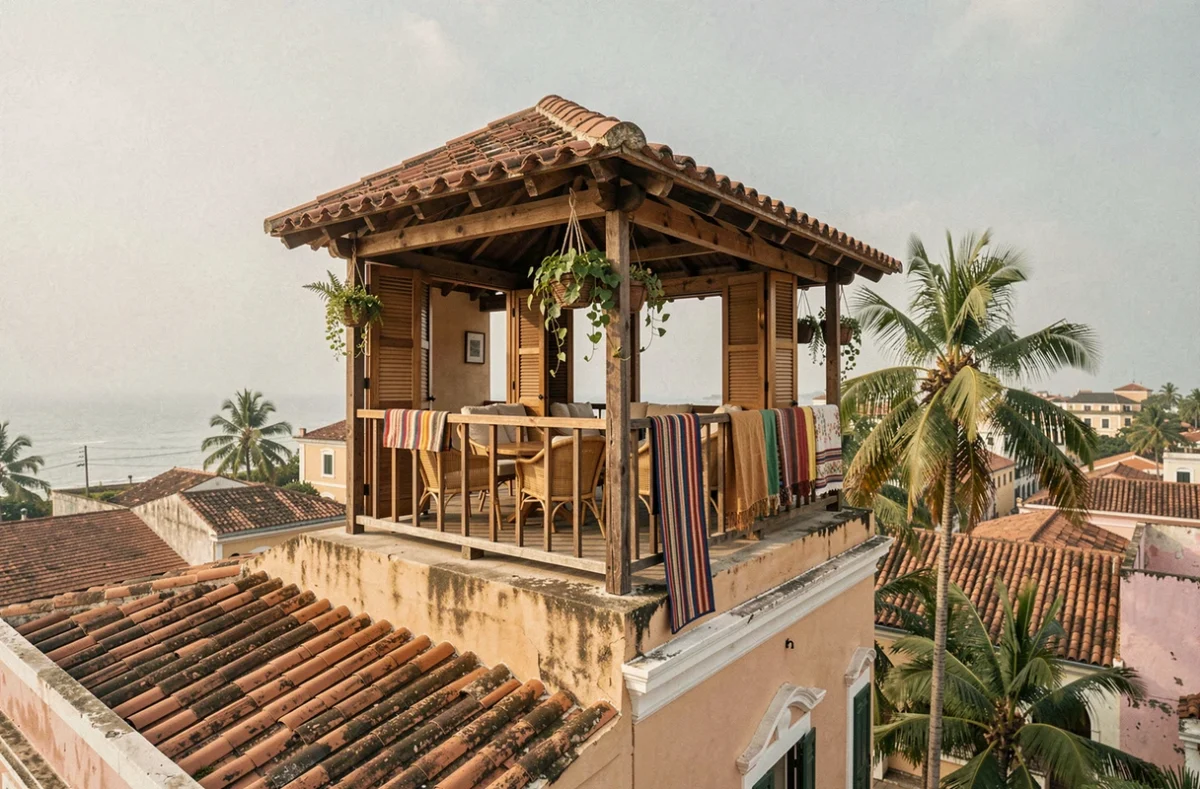
Treehouses and rooftop accommodations share the idea of altitude, but the experience diverges on all other levels. In the forest, the stay focuses on disconnection, silence, and immersion in nature. On a rooftop in the city, it’s the panoramic view, proximity to restaurants, and access to transportation that dominate.
The choice depends on the type of trip sought: a weekend of rejuvenation in an eco-lodge in the heart of the Alps or Mont-Blanc is nothing like a night on the roof of a hotel in Athens or Copenhagen. Both formats are developing, but they do not meet the same need.
However, one common point persists: in both cases, the quality of acoustic and thermal insulation determines traveler satisfaction much more than the spectacular nature of the location. A poorly insulated wooden cabin at altitude becomes uncomfortable as soon as the temperature drops, just like a dome on an urban rooftop exposed to traffic noise.
Sustainability and eco-design of perched accommodations
The ecological positioning has become a differentiating argument for unusual accommodations. Travelers who choose a perched cabin or a stay on a rooftop often seek an approach consistent with the surrounding nature.
Bio-sourced materials (local wood, plant fiber insulation), rainwater management, and partial energy autonomy (solar panels) are the most common markers. Sustainability serves as a selection criterion for an increasing number of travelers, beyond simple marketing arguments.
On a rooftop, eco-design takes on an additional dimension: the greening of the roof around the accommodation improves the thermal insulation of the building while creating a landscaped setting. This dual benefit explains why several recent projects incorporate green roofs from the design phase.
The market for perched accommodations, whether in the forest or on a rooftop, is structured around these technical and environmental requirements. The unusual nature of a night at altitude is no longer enough: it is the robustness of the design, regulatory compliance, and ecological coherence that separate a memorable stay from a disappointment.