
Children today are growing up in a dense media environment, with podcasts, adapted newspapers, and regulated digital platforms. Keeping up with trends in the children’s universe allows parents to make more informed choices, whether for leisure, toys, or educational content offered at home.
Podcasts and audio formats for children: a structured offering
Have you noticed that your child is more willing to listen to a story being told than to read a text on a screen? This reflex partly explains the success of children’s podcasts in recent years.
Children’s publishers and French-speaking radio stations have multiplied news podcasts for 7-12 year-olds in the form of short capsules. These episodes typically last between five and ten minutes, a format designed to capture attention without overwhelming.
In France, several collections have emerged around targeted themes: ecology, elections, conflicts explained to the youngest. These topics are addressed with everyday vocabulary and concrete examples, so that the child can relate what they hear to what they observe around them. New selections and angles can regularly be found in the articles published on Annuaire des Enfants, which cover this type of adapted audio content.
The audio format has a pedagogical advantage that is often underestimated: it engages the imagination without imposing an image. The child mentally constructs the narrative, which strengthens both oral comprehension and attention span.
Child reporters: when young people participate in news production
Since 2023, a movement has been gaining momentum in French-speaking youth newsrooms. Children are directly participating in content production, under the supervision of professional journalists.
The “Young Reporters” program from Radio-Canada, relaunched and expanded to elementary schools in 2024, illustrates this approach well. Children conduct micro-interviews, carry out short interviews, and co-write news analyses. This initiative also exists in Belgium and France, in various formats.
The goal goes beyond simple entertainment. It is about media education: learning to verify a source, distinguish fact from opinion, and formulate a question. These skills, developed from primary school, help combat misinformation at an age when critical reflexes are being built.
In practical terms, a child who has participated in the production of a report understands better how information works. They know that a headline can be misleading, and that an image can be taken out of context. This type of program serves as an educational tool that parents can extend at home by discussing the topics covered.
Toys and educational games: what is changing in the sector in France
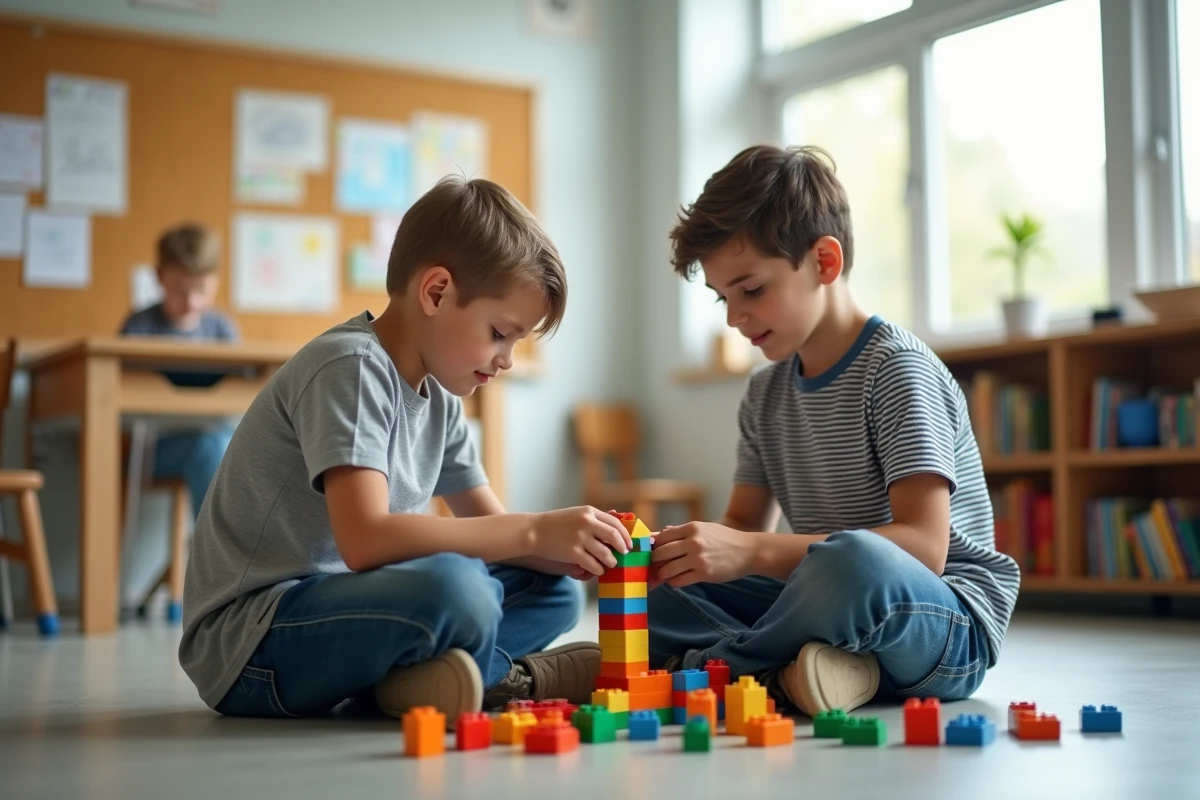
The toy market in France is undergoing a period of restructuring. Sales of connected toys are slowing down in favor of more tangible games: construction games, cooperative board games, scientific kits.
Why this shift? Several factors converge:
- The parental demand for screen-free games is significantly increasing, driven by recommendations to limit screen time for young children.
- Historical toy franchises and brands are re-launching classic ranges in updated versions, focusing on the durability of materials and replayability.
- Board game publishers are multiplying cooperative references, where players win or lose together, aligning with an educational approach that values collaboration over competition.
The toy sector in France remains dynamic, but the selection criteria for parents are evolving. The educational mission of a game weighs more heavily in the purchasing decision than it did a few years ago.

Franchises and brands: a renewal of catalogs
Several specialized retailers are adapting their catalogs to reflect these new expectations. The emergence of thematic selections by skill (motor skills, logic, creativity) rather than just by age group is becoming more common. This segmentation helps parents target a specific need.
French brands, in particular, are gaining visibility through short supply chains and local manufacturing highlighted as a quality argument.
Online child protection: regulatory frameworks are strengthening
In 2024 and 2025, several European countries and Canada tightened their rules on digital content aimed at minors. These developments directly affect parents and content publishers for children.
The main measures focus on limiting advertising targeting minors and regulating recommendation algorithms. The idea is simple: an eight-year-old child should not receive the same content suggestions as an adult.
For families, these developments have concrete consequences:
- Video platforms must offer stricter child modes, with enhanced content filtering.
- Educational applications are subject to transparency obligations regarding data collection.
- Publishers of children’s podcasts and digital magazines are adapting their practices to comply with new requirements.
Parents remain the first filter, but these regulations create a framework that limits the risks of exposure to inappropriate content. Checking that the applications and websites used by your children clearly display their data policies remains a useful precaution.
Screens and recommendations: beyond the binary debate
The issue of screens among children goes beyond the question of “for or against.” What matters more is the nature of the content consumed and the context of use. An educational podcast listened to as a family does not have the same effect as a passive video stream consumed alone.
Child specialists recommend accompanying rather than prohibiting, by choosing age-appropriate content supervised by professionals (journalists, educators, teachers). This is precisely what the aforementioned youth news formats offer.
The children’s universe is evolving rapidly, with new audio offerings, active participation of young people in news production, and strengthened digital protections. Each family can rely on these trends to build an adapted media environment, combining listening, play, and discussion around topics that affect the youngest.